Segment Tower
A changing silhouette, a repeatable floor.
Overview
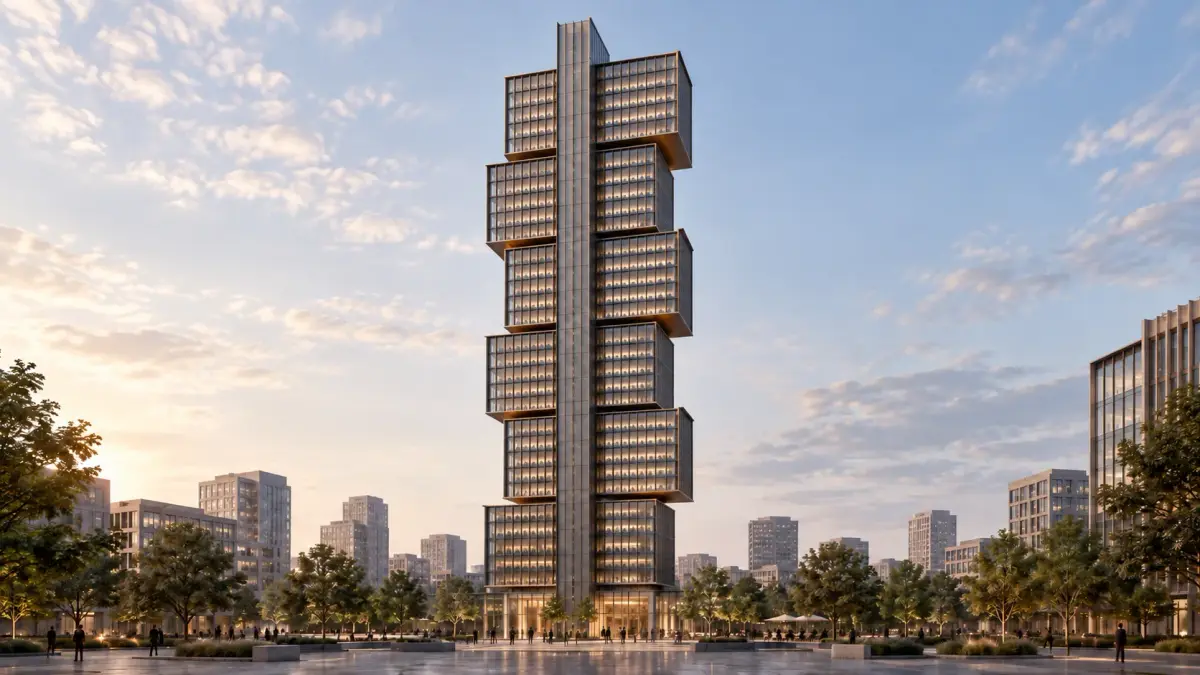
Six seven-storey segments change orientation around one continuous circulation core. The stepped junctions give the 42-storey tower its silhouette. A repeated rectangular facade frame provides a second, smaller rhythm across these larger shifts.
The study asks where variation belongs in a tall building. Massing changes at segment boundaries; the core and panel width remain fixed. At the scale of the facade, shallow and deep openings are compared within the same frame, so the effect of depth can be discussed separately from the overall form.
Design question
Where should a tall building vary, and where should it repeat?
- Location
- Urban workplace scenario
- Client
- Self-initiated Fraktal study
- Team
- Fraktal
- Earlier study
- 2024
One frame, changing depth
Fixed frame / variable reveal
Fixed frame / variable reveal
A shallow reveal sits within the fixed rectangular facade frame.
Schematic design study. It does not verify dimensions or performance.
Design Process
A continuous core
One vertical circulation core connects the six segments. Changes in the envelope are organised around that common reference.
Changes at the junctions
Orientation changes every seven storeys. The segment junctions carry the formal transformation while floors within each segment repeat.
One frame, different depths
A fixed rectangular panel is compared with shallow and deep fins. The study isolates depth without changing the frame width.
Questions in conversation
Peter Eisenman / House VI
Eisenman describes House VI as a record of transformations rather than simply their end product. Here that idea directs attention to the segment junctions: a reader should be able to reconstruct where the tower changes and which rules remain fixed. Construction and occupation would then test those formal rules.
Eisenman Architects / House VI ↗Drawings & gallery
Compare design states and spatial relationships. Open an image to inspect the details.
Technical details
The concept programme, design inputs and proposed systems.
- Programme target
- 42 storeys / 6 segments
- Envelope rule
- Repeated rectangular panels
Material Palette
- Gray metal
- Panel frames and segment edges.
- Bronze-tone fins
- Depth and a changing facade rhythm.
- Neutral glass
- A consistent glazing family.
Tools
Plan and section study · Schematic architectural drawings · AI-assisted concept visualization
Workplace · Computational design · Concept
Design decisions and limits
Variation with a sequence
A small number of segment junctions produces the changing silhouette. Each shift can be traced back to the same core and floor rule.
Depth has consequences
Deeper fins alter the viewing aperture as well as the geometry of shade. Their daylight and solar performance has yet to be tested.
Next steps
Transfer structure at segment junctions, wind response, escape routes and facade maintenance require specialist development. Daylight and solar analysis would be needed to choose between panel depths.