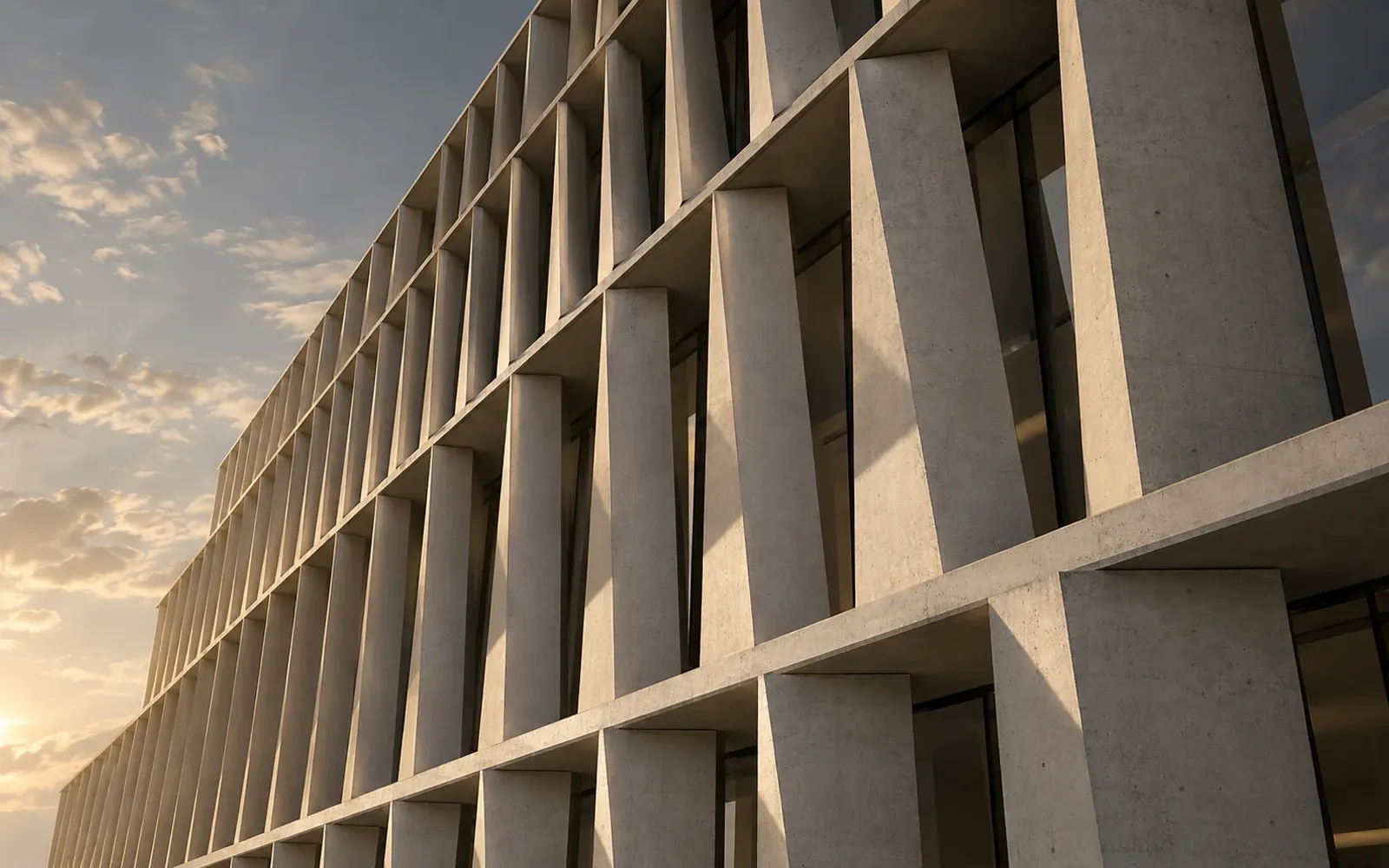
Generative Facades
Study facade geometry through shade, outward views, fabrication and maintenance.
- Study period
- 2023-2025
- Note updated
The research question
Deepening a shade changes several things at once: sunlight, the outward view and the effort of reaching the glass. Our facade study asks how these consequences can remain legible while a designer explores panel geometry.
The first comparison keeps one office bay, glazing, occupancy and weather file fixed. A simple horizontal shade, vertical fins and a varied panel family will be examined under the same conditions. Daylight, glare and energy implications remain separate objectives.
We also ask what happens when a varied surface becomes a small family of manufacturable parts. Joint design, cleaning access and component count belong in the comparison. Complexity is useful only if the architectural trade-offs can be explained.
Look past the facade surface
The shallow projection leaves more of the opening exposed along the assumed ray direction. The room and glazing stay fixed.
Illustrative section with one assumed ray direction. Shadow and view lines explain geometry only; they do not report lux, glare, cooling demand or annual performance.
Ideas and methods
Harvard MaP+S studies the relationship between material behaviour, making and design. Its 2026 reconfigurable-inflatables work connects surface geometry to a physical material experiment. We draw a methodological lesson from that relationship: a varied facade needs a part, a joint and a test that another designer can inspect. Radiance and Honeybee support the separate daylight and energy assessments.
Read the sources ↓Current work and the next experiment
- On this page
- A shade-depth section comparison under one illustrative ray direction.
- Planned output
- Reproducible environmental inputs and outputs, a part schedule and a representative joint prototype.
How we will test it
- Create one reproducible bay
- Record room geometry, north, weather file, glazing, occupancy and sensor positions. Run an unshaded or existing-facade reference with the same settings.
- Keep the objectives separate
- Compare daylight distribution, glare from selected viewpoints and energy implications. Show conflicts between them instead of collapsing them into a single green score.
- Translate the surface into parts
- Group panel geometries, identify a representative joint and test assembly and cleaning access. Record what is lost when the design is simplified for manufacture.
What remains open
- No verified simulation outputs or physical test records accompany this note.
- Glare, maintenance and seasonal use require separate review.
- A digital panel family does not establish fabrication cost or structural suitability.
Next output
The next output is a facade-bay comparison with input settings, environmental results and a component schedule on the same sheet. A representative panel and joint can then be prototyped. The research is intended to make facade decisions easier to review, with measured performance claims following the simulation and physical checks.
Sources and method notes
- Greg Ward, The RADIANCE Lighting Simulation and Rendering System (1994) ↗
The rendering and lighting simulation method considered for daylight evaluation.
- Honeybee: Annual Daylight ↗
Official recipe inputs, occupancy assumptions and daylight-calculation settings; checked 15 September 2026.
- Ladybug Tools: Honeybee ↗
Official overview of separate Radiance daylight/glare and EnergyPlus/OpenStudio energy workflows.
- Yang et al., Reconfigurable Inflatables Through Controlled Surface Crumpling (2026) ↗
Material experiment listed by Harvard MaP+S; a reference for linking geometry and physical testing.