Micro Living
One room, three ways to live.
Overview
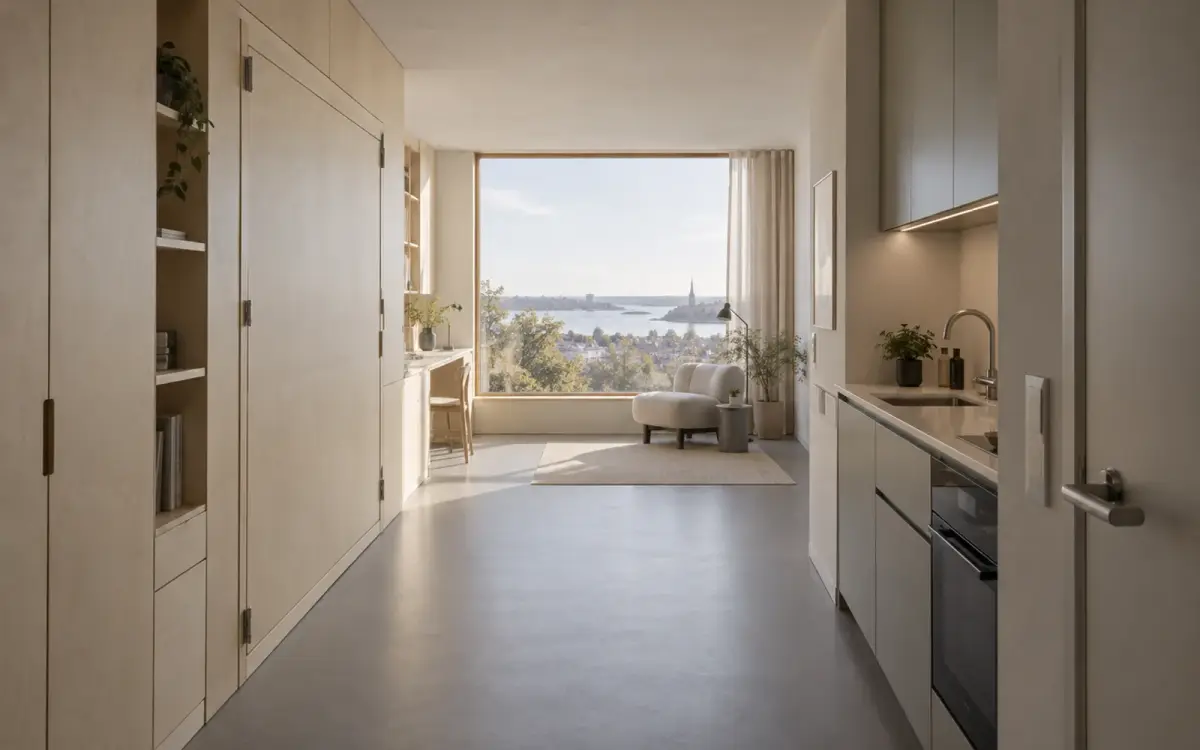
A 4 × 7 m apartment is organised around the time of day. Kitchen and bathroom occupy the entrance end; a birch plywood wall stores belongings and a folding bed. The table uses the window end for work and meals, then moves before the bed opens. Fixing the services at one end lets the living space change without moving plumbing or enclosing a second room.
The 28 m² shell stays the same across all three arrangements. Furniture footprints are compared with the route from the entrance to the window, including the space needed while pieces are moving. Opening the bed also requires a place for a chair, laptop or meal to go. Compactness depends on a manageable daily sequence as much as on the final arrangement.
Design question
Can the furniture be rearranged without blocking the route through the room?
- Location
- Compact apartment scenario
- Client
- Self-initiated Fraktal study
- Team
- Fraktal
- Earlier study
- 2023
One room across the day
Services · Daylight →
Services · Daylight →
Services · Daylight →
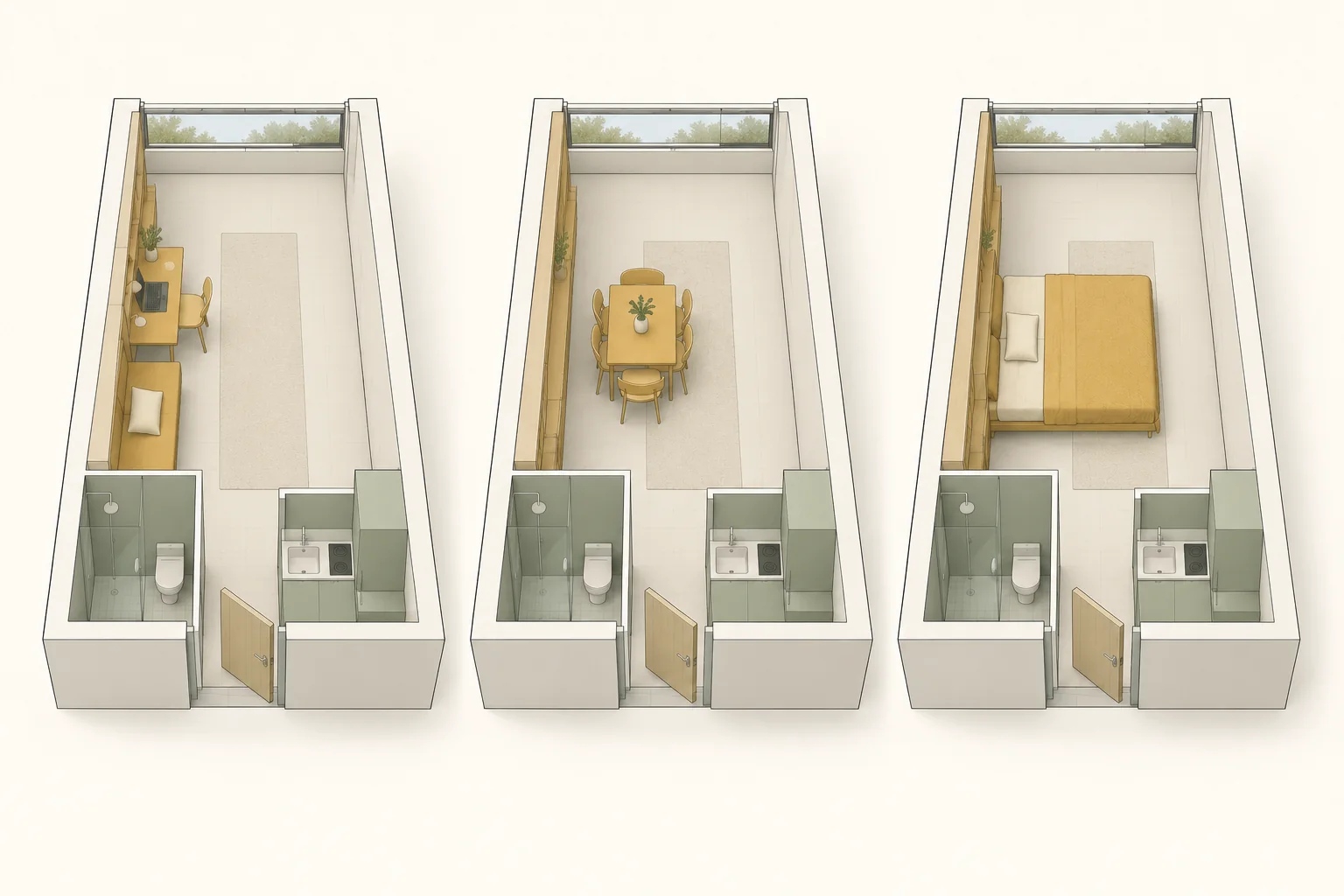
The bed folds into the storage wall. The table faces the window, leaving the centre available for work.
Schematic design study. It does not verify dimensions or performance.
The fixed edge and the changing room
Keeping the shell, kitchen and bathroom in place makes the changing furniture arrangement the focus. The views compare occupied and clear floor across three daily uses. Furniture dimensions, movement clearances and connections still need a detailed plan and a full-scale prototype.
 View larger
 - Services remain fixed
- Kitchen and bathroom anchor the entrance end. Their position sets the boundary for the living space rather than changing with each furniture arrangement.
- One floor, different times
- The table and folding bed need the same floor at different times. Their relationship is read as an order of operations, including the space needed between states.
- A route through the room
- The entrance-to-window route is checked beside the furniture footprints. Clear access during a change is a separate question from the path left after it.
Design Process
A fixed service zone
Kitchen and bathroom share the entrance end, keeping their plumbing in one zone. The window end remains a continuous living space. This division gives the moving furniture a clear boundary, though service depth still limits the usable floor.
The order of moving
The table moves toward the window before the bed opens. Comparing work, meal and rest footprints on one plan identifies competing uses. The in-between arrangement also matters: the user needs somewhere to stand, move a chair and put away everyday objects.
Parts within reach
Plywood panels, hinges and folding supports are treated as separate parts. Their position should allow the mechanism to be operated and inspected without emptying the whole room. A full-scale detail is needed to assess weight, stability and repair access.
Questions in conversation
David Greene / Living Pod
Living Pod reconsiders the home through equipment and services. Reading Greene’s proposal raises a question for this study: which tasks belong to the fixed service zone, and which can move with the furniture? The shell stays in place; the daily rearrangement becomes the design problem.
Frac Centre-Val de Loire / Living Pod ↗Drawings & gallery
Compare design states and spatial relationships. Open an image to inspect the details.
Technical details
The concept programme, design inputs and proposed systems.
- Shell
- 4 × 7 m / 28 m² design input
- Configurations
- Work, eat, rest
Material Palette
- Birch plywood
- Storage and folding furniture.
- Gray linoleum
- A continuous, replaceable floor finish.
- Dark hardware
- Accessible hinges and supports.
Tools
Plan and section study · Schematic architectural drawings · AI-assisted concept visualization
Interior · Computational design · Concept
Design decisions and limits
One floor, successive uses
Work, meals and sleep share the centre at different times. They cannot all occupy it at once.
The cost of changing modes
Opening the bed requires moving the table. The daily sequence must be convenient enough to justify this compact arrangement.
Next steps
Sharing one floor between work, meals and sleep saves separate enclosures, but it reduces the possibility of using them at the same time. A visitor, work left on the table or a user unable to move furniture could change which arrangement is appropriate.
A full-scale mock-up should test the hinge, operating force, support stability and movement sequence. Observe the change with everyday objects in place, then check circulation and access in each state. These tests would establish who the arrangement serves and whether the daily effort is justified.