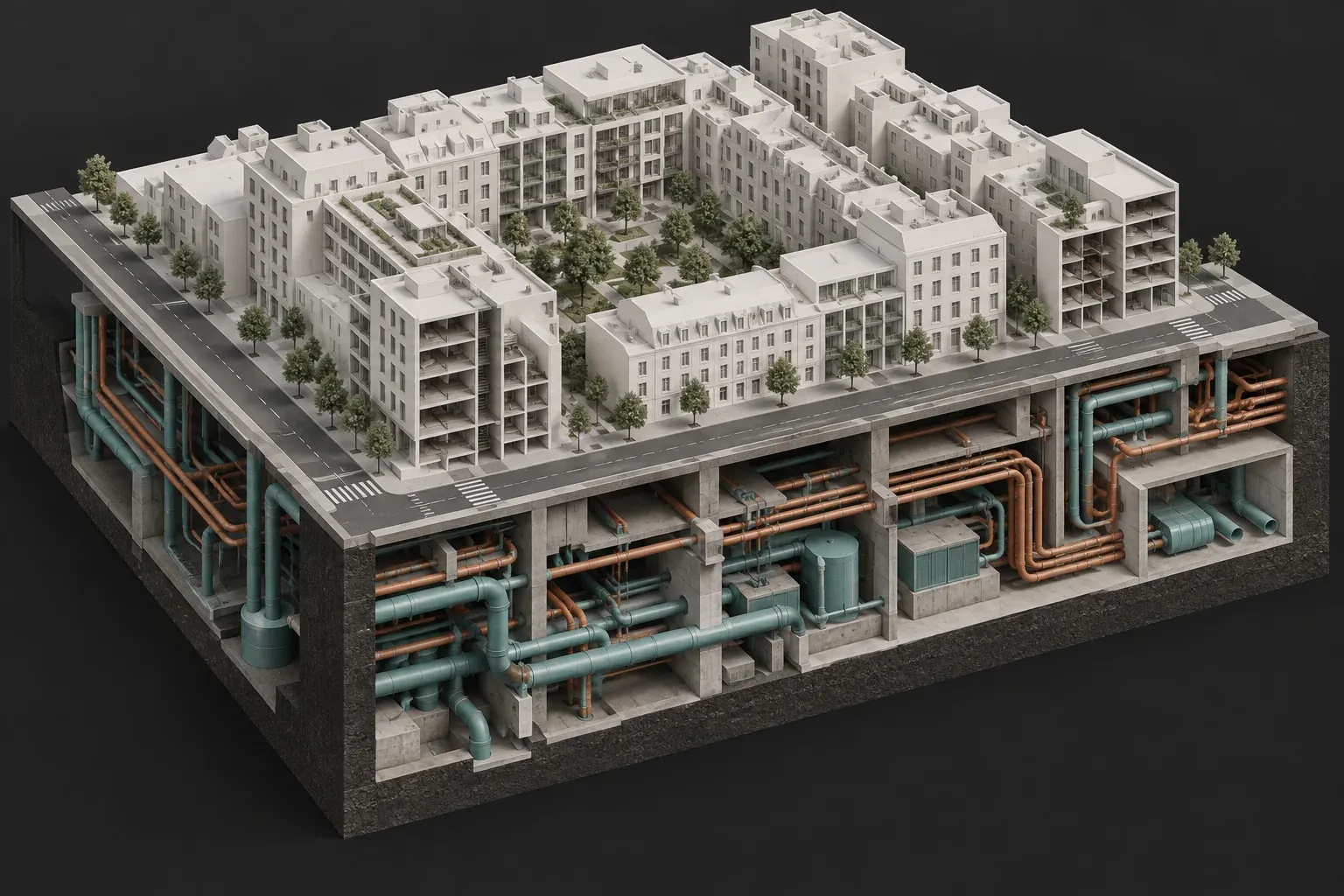
Urban Metabolism
Trace what a block retains, consumes and discards before choosing how to transform it.
- Study period
- 2024
- Note updated
The research question
Buildings carry material, labour and memories beyond their first use. Urban metabolism connects those stocks to the flows that keep a neighbourhood working. We use that perspective to examine a practical choice: retain, adapt or replace part of an existing block.
The comparison will hold programme and study period constant. A material inventory, an energy estimate and an account of everyday access describe different consequences; each needs its own source and boundary. Missing information will remain visible.
Our first deliverable is a worked block-scale account that another reader can recalculate. It will show the sensitivity of a conclusion to quantities, lifetimes and intervention assumptions. This is a method for examining a decision, rather than a ranking of cities.
Trace a block’s changing fabric
The existing fabric remains. A retention proposal would still need to establish repairs, service upgrades and whether the programme fits.
Illustrative building inventory. Filled and outlined elements show what is retained, removed or added; they do not represent material quantities, carbon savings or equivalent usable floor area.
Ideas and methods
Wolman’s urban-metabolism account and the IPCC’s urban-systems assessment inform the accounting scope. Easterling’s work on infrastructure and subtraction adds a design question: how can changing relationships and removing elements become part of an intervention?
Read the sources ↓Current work and the next experiment
- On this page
- An illustrative inventory separating retained, removed and added elements.
- Planned output
- A source-linked material inventory, equivalent scenarios and calculations with explicit uncertainty.
How we will test it
- Define stock and flow separately
- Inventory the buildings and relevant materials at a stated date. Record annual or project-related resource movements separately, with compatible units and boundaries.
- Keep the comparison equivalent
- Use the same programme and study period for retention and replacement scenarios. State which construction, operation, transport and end-of-life effects are included.
- Trace one result back to its source
- Recalculate a selected indicator from source records and test a plausible alternative assumption. Publish missing coverage and the effect of uncertainty beside the result.
What remains open
- A block, source register and inventory date still need to be selected. The diagram is not a material survey.
- Retention and replacement need an equivalent programme and accounting period before their resource demands can be compared.
- Missing quantities, material composition and end-of-life assumptions can change an assessment. Their coverage must remain explicit.
Next output
The next output is a block-scale account linking a material inventory to explicit adaptation scenarios. A data dictionary and worked calculation will make each quantity, boundary and assumption traceable. The comparison will put resource demands beside the spaces and uses retained by each intervention, so another reader can examine where the alternatives differ.
Sources and method notes
- Abel Wolman, The Metabolism of Cities (1965) ↗
Scientific American 213(3). The founding article of urban metabolism.
- Kennedy, Cuddihy and Engel-Yan, The Changing Metabolism of Cities (2007) ↗
Journal of Industrial Ecology 11(2). Metabolic accounting across world cities.
- IPCC AR6 WGIII, Chapter 8: Urban Systems and Other Settlements (2022) ↗
Official assessment of urban energy/material flows and emissions boundaries; informs the accounting scope rather than providing project-specific results.
- Keller Easterling, Medium Design and Subtraction ↗
Yale’s account of work on spatial relationships, infrastructure and removal; a conceptual reference for intervention scenarios.