Learning Landscape
Four clusters, one shared centre.
Overview
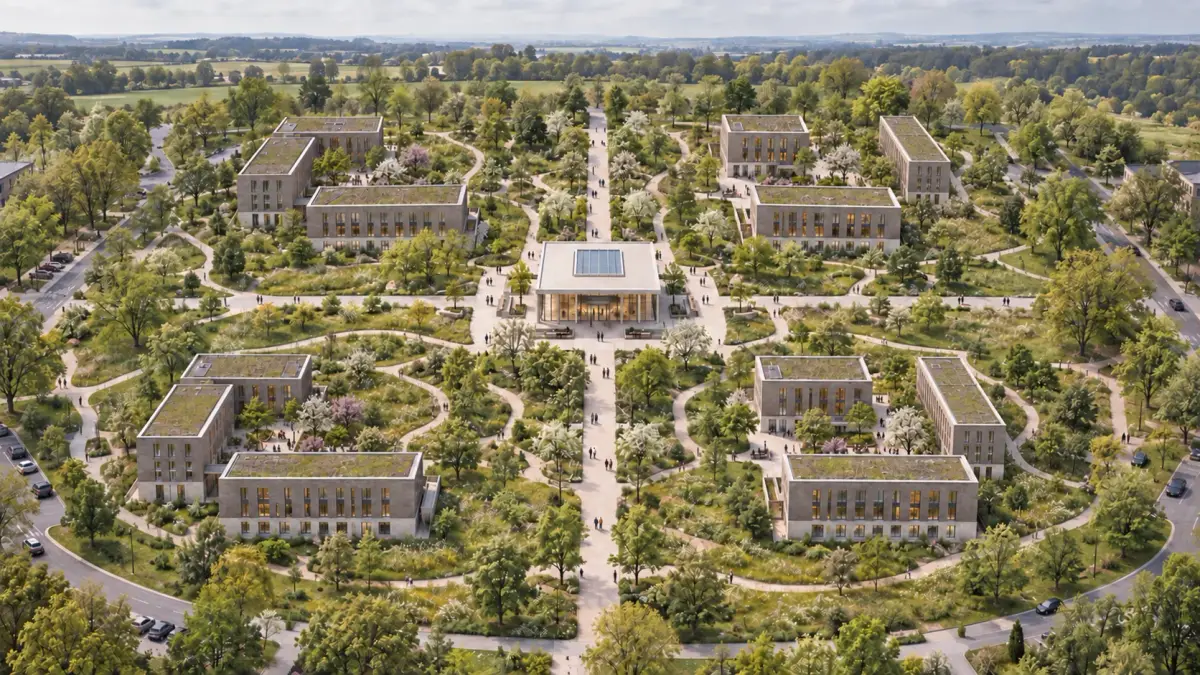
Four clusters of three academic buildings share a central library and learning commons. Two- to four-storey blocks define courtyards along a continuous pedestrian network. Vehicle and service access remain on the perimeter.
On this 50-hectare site, the journey between classes becomes part of the programme. The study brings entrances, academic clusters and common spaces onto one route network. It asks where a short encounter, a break or informal learning can occur between classes and other scheduled activities.
Design question
How do separate academic groups become part of an everyday shared campus?
- Location
- University campus scenario
- Client
- Self-initiated Fraktal study
- Team
- Fraktal
- Earlier study
- 2023
The route between classes
4 clusters + shared learning centre
4 clusters + shared learning centre
4 clusters + shared learning centre
The main pedestrian network begins at the site’s perimeter entrances.
Schematic design study. It does not verify dimensions or performance.
Design Process
Four academic neighbourhoods
Three buildings define a courtyard in each cluster. This smaller shared space sits between the individual entrance and the campus-wide route.
A centre on the routes
The library and commons occupy the meeting of the main pedestrian routes, connecting shared learning spaces to the journey between clusters.
Services at the perimeter
A peripheral service loop is kept separate from the main pedestrian spine. Its connections to each building need further resolution.
Questions in conversation
OMA / Educatorium
OMA’s Educatorium brings socialising, learning and examination into one continuous trajectory. We read circulation as part of the educational programme and extend that question to the campus: what should happen on the route between academic buildings, courtyards and the common centre?
OMA / Educatorium ↗Drawings & gallery
Compare design states and spatial relationships. Open an image to inspect the details.
Technical details
The concept programme, design inputs and proposed systems.
- Site input
- 50 ha
- Organisation
- 12 academic blocks + shared centre
Material Palette
- Brick
- A common language for academic blocks.
- Stone paving
- Connected courtyards and paths.
- Deciduous planting
- Seasonal shade along the walking network.
Tools
Plan and section study · Schematic architectural drawings · AI-assisted concept visualization
Campus · Computational design · Concept
Design decisions and limits
A route at several scales
The same network links the site entrances, local courtyards and central commons. Each place has a role in the journey across campus.
Learning between buildings
Courtyards and planted paths offer settings for breaks and informal encounters. Their usefulness depends on how academic timetables and actual routes overlap.
Next steps
Timetables and travel demand should test the route network. Accessible gradients, building service connections and planting appropriate to the local climate need to be resolved on actual site levels.