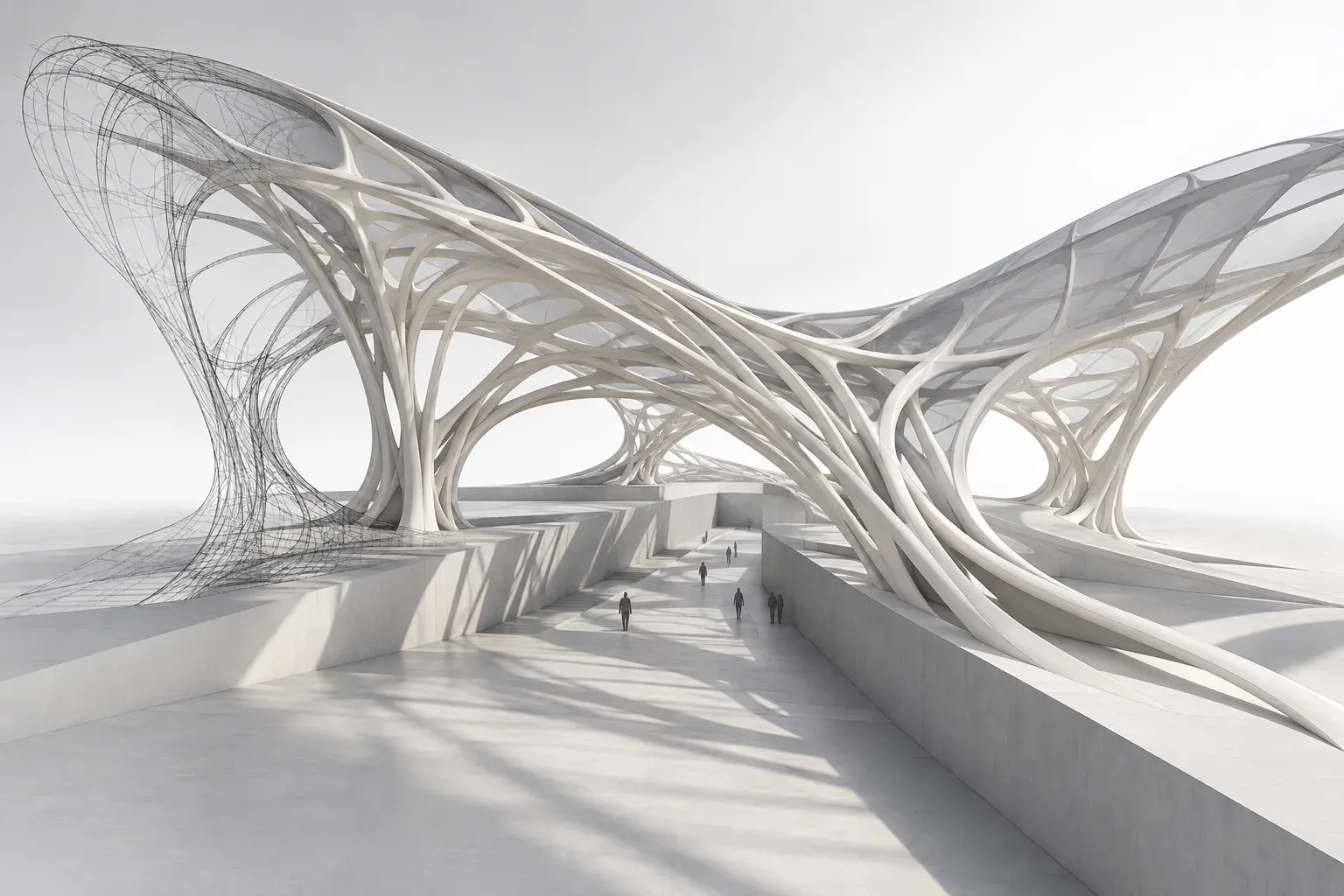
AI Form Finding
Explore a form while keeping its geometry, material and structural assumptions open to review.
- Study period
- 2024-2025
- Note updated
The research question
Form finding begins with relationships: a span, supports, a material and forces. We investigate how AI-assisted exploration might contribute to that process while making those relationships explicit for architectural and engineering review.
A canopy is the first proposed case. A simple parametric baseline and generated candidates would share the same brief and load assumptions. Visual character, geometric validity and structural assessment will be checked separately; each conversion between representations needs a record.
Before proposing a trained generator, we will test a small set of interpretable geometric operations. The question is whether they produce alternatives that can be revised and explained. Rejected geometry and sensitivity to modelling choices are part of the intended output.
Change the rise, keep the brief
The canopy is shallow between the same two supports. The small rise changes the geometry of its members and connections.
Geometric comparison only. Arrows indicate an assumed load direction, not calculated forces. The diagram contains no structural solver, safety assessment or material-saving result.
Ideas and methods
Frei Otto’s physical models connect form with material and forces. Parametric structural methods make some of those relationships explicit in computation. We take this as a reason to inspect the chain from proposal to analysis, rather than treating a generated image as an engineered form.
Eisenman’s account of House VI describes form as the record of a sequence of transformations. That is a useful counterpoint to force-based form finding: a legible transformation is not necessarily a structural response. In the canopy study, each operation must state whether it changes an architectural relationship, a geometric constraint or an analysis assumption.
Read the sources ↓Current work and the next experiment
- On this page
- Three illustrative canopy profiles with unchanged supports.
- Planned output
- A parametric baseline, analysis inputs, candidate and rejected geometry, and an engineer’s review.
How we will test it
- One brief, comparable geometry
- Use the same roof outline, clearance, material assumptions and supports. Include a simple reference structure and reject disconnected or invalid geometry before ranking alternatives.
- Check sensitivity
- Repeat selected cases with refined meshes and changed support assumptions. Record deflection, stability checks and solver warnings separately from the image’s visual appeal.
- Review a buildable detail
- Choose a representative connection and examine assembly, member access and fabrication limits with an engineer. A favourable global model can still hide an impractical joint.
What remains open
- No verified training records or independent structural benchmark accompany this note.
- Simplified analysis depends on material, support and load assumptions.
- Visual novelty and numerical feasibility do not establish usability or construction readiness.
Next output
The first deliverable is a canopy experiment containing the brief, parametric baseline, candidate geometry, analysis settings and rejected cases. Each alternative should make its geometry and assumptions available to an engineer, including why it was retained or abandoned. Connection design and fabrication review would then establish what needs to change before the proposal can be built.
Sources and method notes
- Frei Otto and Bodo Rasch, Finding Form ↗
Edition Axel Menges, English edition listed by its distributor in 1996. A reference for lightweight, adaptable form and the relationship between design and physical constraints.
- Clemens Preisinger, Linking Structure and Parametric Geometry (2013) ↗
The structural modelling framework considered for candidate evaluation.
- Karamba3D: Buckling Modes ↗
Documents the distinction between member assumptions and global stability checks; checked 15 September 2026.
- Karamba3D: Performance Optimization ↗
Guidance on load-case calculation and mesh refinement, used to define sensitivity checks.
- Peter Eisenman, House VI (1972–1975) ↗
The architect’s account of a built form that retains its generative history. Informs how transformations are documented, rather than the structural validity of a candidate.
Research connections to our products
- Constraint-driven generation in Archly Exploration
A possible future direction is to bring reviewed generated geometry into Archly. Current visualization output does not constitute structural validation.
Archly → - Exploring form alternatives in Grasshopper Exploration
Falcon remains a research tool. Parameter exploration and a physics-feedback experiment would need a separate implementation and evaluation.
Falcon AI →