Reading BIG’s Mountain through its section
Housing and parking meet in one sloping section. The Mountain shows how a clear diagram can make a design choice readable, while leaving other questions open.
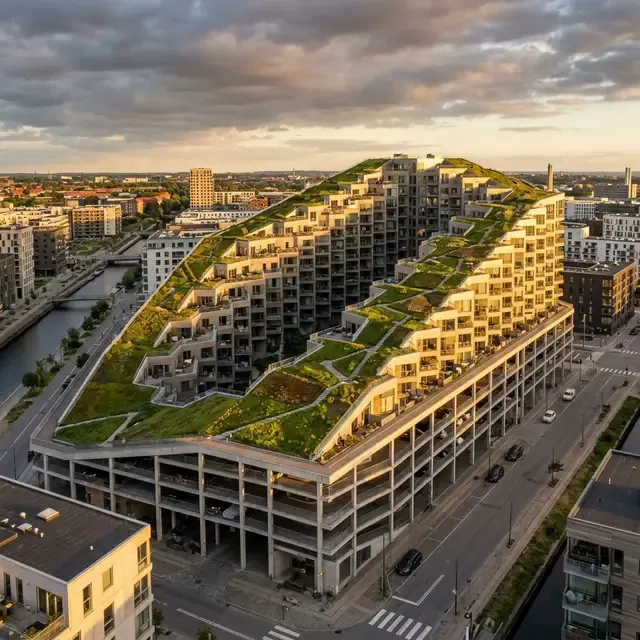
BIG presents The Mountain through a sequence of programmatic moves: housing and parking begin as separate requirements; parking becomes a podium; its surface slopes into a zigzag section; garden homes occupy the top. One programme gives the other a ground to inhabit.
A section carries a value judgment
Our reading starts with that allocation. Parking is given a large presence in the building, while the homes gain access to outdoor space above it. The section makes those priorities visible. Another brief, or another judgment about shared ground and private gardens, could produce a different relationship.
A sequence of simple diagrams can make the final frame seem inevitable. To read it critically, we need to ask which alternatives fell away and which preference made this one persuasive. Clarity helps us discuss the choice; it does not settle the choice for every site.
Change the premise and redraw
For a comparable housing study, we would draw a conventional block and a stepped arrangement against the same brief. Access, service routes and the site boundary would stay visible in both. Then we would change one premise, such as the amount of parking or the importance of private outdoor space, and redraw both options.
The section should reveal how people reach their homes, how terraces overlook one another and how building depth affects the rooms. An area table would sit beside those drawings. Privacy, arrival and the experience of shared space would still need architectural interpretation.
A rejected option belongs in the record too. It can show what the preferred terraces cost in sectional complexity, or what a simpler access route gives up in outdoor space. Those trade-offs explain why a decision is appropriate to this brief.
Computation follows the question we choose
BIG’s published design sequence explains a project. It does not document an optimisation algorithm. In our own computational comparison, the first task would be to state the brief and explain why each property matters before turning it into a variable.
The Mountain is a useful reference because its section makes a formal and programmatic relationship discussable. A diagram becomes an argument when the next drawing can examine its assumptions and consequences.