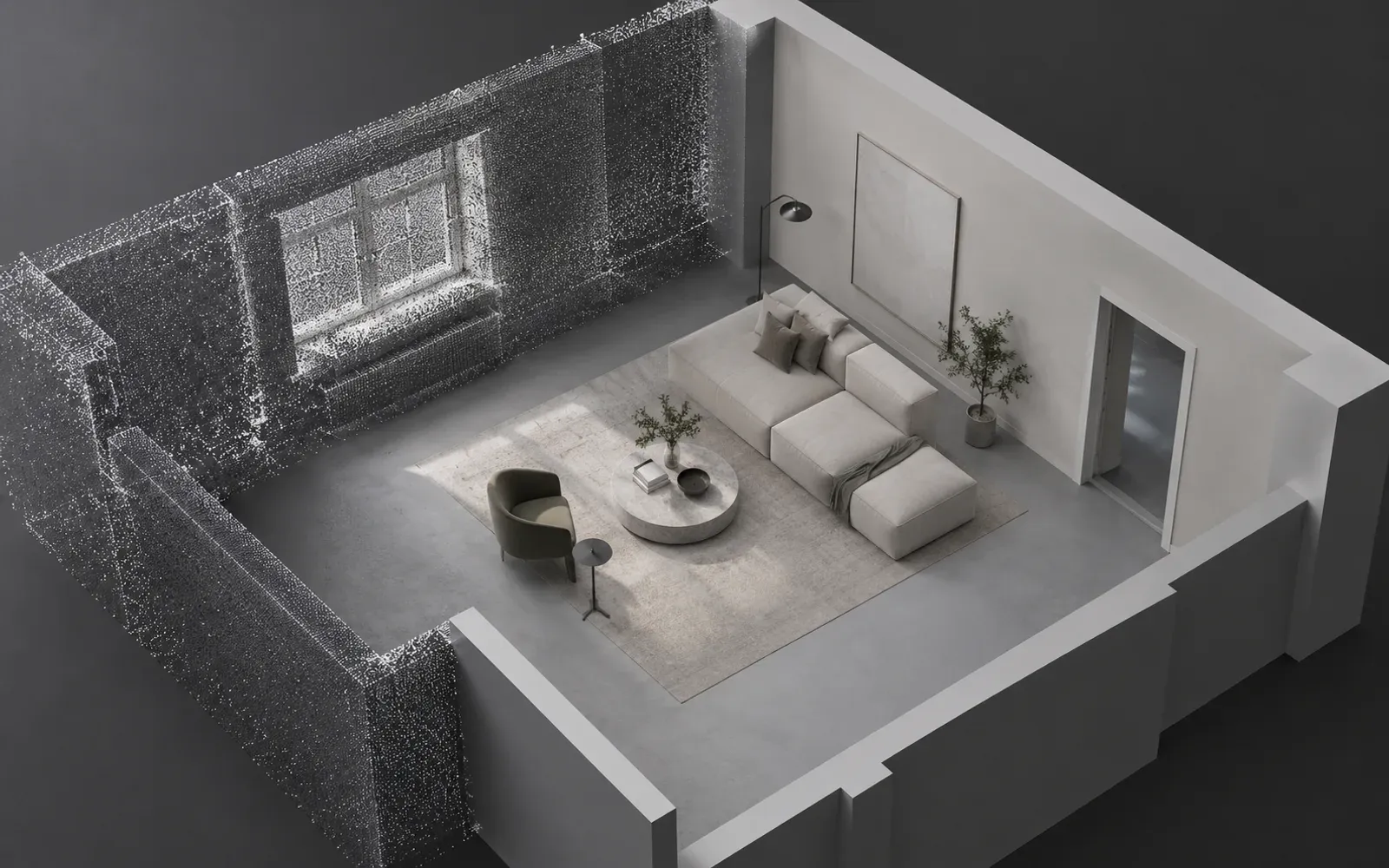
Scan to Editable Model
How can a scan become architectural elements whose sources and relationships survive an edit?
- Study period
- 2026
- Note updated
The research question
A scan records the visible room. A renovation project needs a model that can answer a different question: what happens to the doorway when its wall moves? We are investigating the transition from captured surfaces to architectural objects, while keeping the observation available for inspection.
The first experiment is deliberately small: one room, an independently measured reference and a sequence of wall and opening edits. Each object would retain its source, units and relationships. Observed, inferred and manually corrected geometry would remain distinguishable after saving and reopening the model.
The hypothesis is that this structure reduces the work needed to prepare and revise a usable model. A cleaner-looking mesh alone cannot establish that. We will compare accepted edits, broken relationships and manual repair effort before considering a learned reconstruction model.
Move the opening, retain the source
The editable doorway sits over its source reference. A gap in the source boundary remains dashed instead of becoming a silently confirmed wall.
Schematic source points, not a real room scan. The dashed missing boundary is inferred; solid geometry is the proposed editable model. These states illustrate a research requirement, not a released SpaceCraft feature.
Ideas and methods
RoomPlan and SceneScript demonstrate different ways to represent an observed room as structured elements. They motivate a question beyond reconstruction: can an architect revise the representation without losing its link to the source? Fraktal’s proposed contribution is source-aware editing and its evaluation, rather than a claim to have reproduced either system.
Read the sources ↓Current work and the next experiment
- On this page
- A schematic doorway edit with a fixed source reference and an explicit missing boundary.
- Planned output
- A cleared room capture, independent measurements, editable files and a record of accepted and failed edits.
How we will test it
- Keep an independent reference
- Measure selected lengths and opening locations separately from the capture. Record inaccessible surfaces and avoid using the reconstructed model as its own reference.
- Test edits, not only exports
- Move a boundary, change an opening and reopen the saved file. Check units, object identities, wall-opening relationships and unintended changes.
- Record uncertainty and repair
- Track inferred geometry, manual corrections and the time needed to reach a usable model. Include rooms with clutter and difficult surfaces rather than only clean demonstrations.
What remains open
- Furniture, reflective surfaces and incomplete coverage can leave ambiguous observations. A plausible completion would still need an explicit inference label.
- A room surface does not establish concealed construction, wall composition or structural behaviour. Those properties are outside the initial scope.
- An editable exported object may lose relationships in another application. Each intended destination and its supported information require a separate test.
- Reference rooms, device coverage and acceptance criteria still need to be selected. This proposal does not establish suitability for construction or fabrication.
Next output
The next output is a room capture cleared for use, paired with reference measurements, an editable model and a short edit history. A walkthrough will include both a successful edit and a failure. These records will define what an editable capture must preserve, including the relationships that need checking when the model moves to another application.
Sources and method notes
- Apple: RoomPlan overview ↗
Parametric room representation and export formats; accessed 14 September 2026.
- Apple: ARMeshGeometry ↗
Mesh representation and per-face classification; accessed 14 September 2026.
- Rhino 8: Units ↗
Model units, tolerances and unit changes in a possible target application; accessed 14 September 2026.
- Apple: 3D Parametric Room Representation with RoomPlan ↗
Primary technical account of room understanding and parametric representation.
- W3C: PROV Model Primer ↗
Primary guidance on entities, activities and responsibility in provenance records; used as a reference for the proposed edit history.
- Avetisyan et al., SceneScript (2024) ↗
Structured scene commands inferred from visual observations; a reference for representation, not a Fraktal result.