When AI finds the form
GPT-6 Astra brings AI agents into the modeling process. An introduction to LLMs, diffusion and the architectural decisions behind a convincing form.
Imagine describing a pavilion and returning to a modeled roof, a furnished scene and a carefully lit view. The unsettling part is how familiar the result might feel: the kind of image that once stood at the end of a long studio exercise. If a machine can produce that image and the geometry behind it, what happens to the work we call form-finding?
The question reaches beyond drawing faster. It asks how much architectural value we have attached to a striking silhouette, and what else must be present for that silhouette to become a place worth making.
From image generation to an agent at work
A large language model, or LLM, generates language and code. Multimodal models can also work with inputs such as images. GPT-6 Astra accepts text and image input; connected tools extend what it can do. A screenshot gives it a view of an application. File access can give it code to inspect and revise.
Diffusion describes another approach to generation. In image diffusion, a model learns to reverse a process that adds noise, producing an image through denoising steps. Text or image inputs can guide the result. These terms describe different parts of a system: a model may interpret a brief, call an image tool or write code for a modeling application.
An agent connects those actions into a loop: act, inspect the result, then decide what to do next. OpenAI’s computer-use documentation describes returning screenshots after actions. This makes visual feedback part of the process, while leaving open whether the agent has judged the result correctly.
OpenAI’s published Astra house study makes this tangible. The agent used Blender’s Python API, inspected preview renders and revised the scene. The author then requested a floor plan before expanding the house. It is a visualization example, with professional review of site, structure and building requirements still needed. Our earlier Astra article follows that workflow; here we are interested in what it changes about design judgment.
What does finding a form resolve?
In structural form-finding, geometry can emerge from the relationship between loads, supports and equilibrium. ETH Zurich’s eQUILIBRIUM teaching makes that relationship explicit through graphic statics. A curved roof generated for its appearance has not, by that fact alone, resolved those relationships.
Architecture also asks broader questions of a form. Where does someone arrive? What belongs in shade? Which view deserves an opening? What can be built, maintained and changed? A parameter becomes architecturally useful when we can connect its movement to one of those questions. Calling a surface parametric tells us little about why we would change it.
One pavilion, several architectural choices
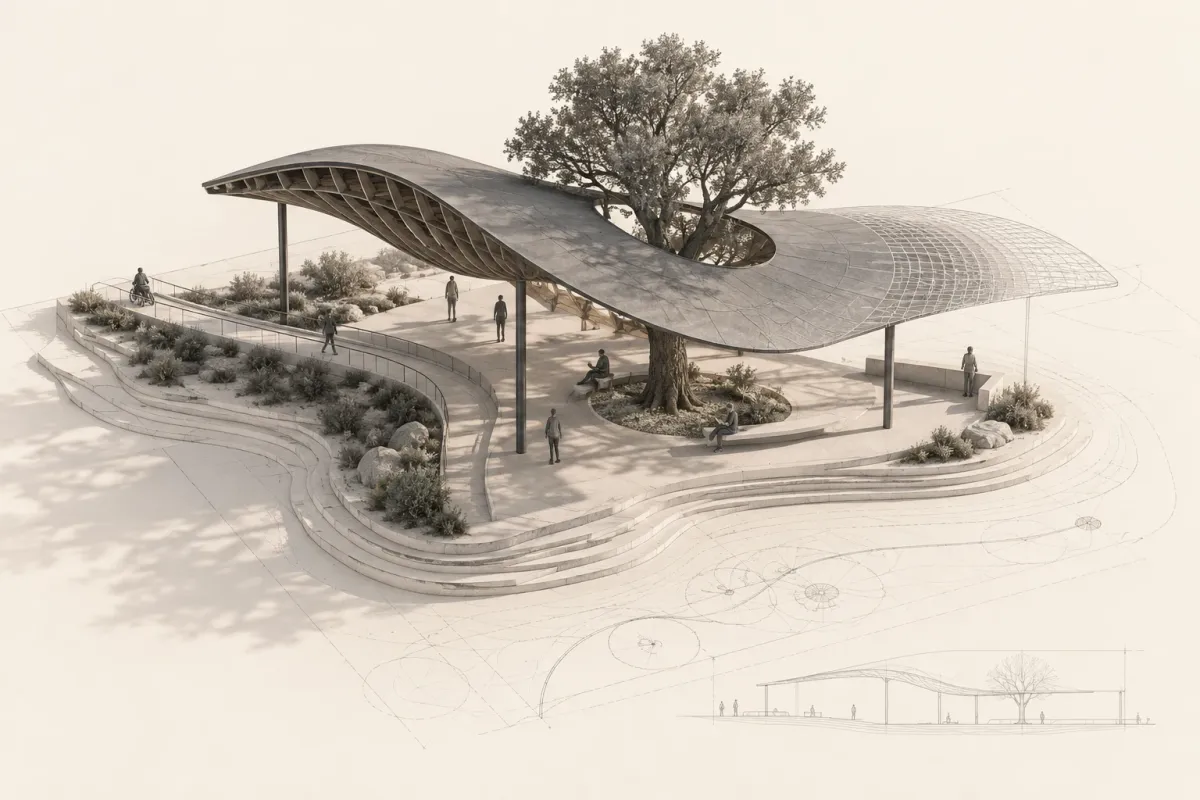
Take the imagined pavilion in the illustration. Asking an agent for a more fluid roof could produce an attractive variation. Asking it to keep a tree, protect a route and give a reader a sheltered place to sit introduces choices that can be discussed in plan and section.
Moving a support out of the path may increase the span. Enlarging the opening around the trunk may change the shade and the way rain reaches the seating. Following the slope may make the approach longer. Each change connects one desirable quality to another consequence. The illustration suggests these questions; answering them would require site information, dimensions and appropriate analysis.
An agent could help explore those consequences, and could propose criteria we had overlooked. We would still need to decide whose movement matters, which compromise is acceptable and what evidence would make us change our minds. Those decisions shape the search itself.
A familiar image and the depth of a project
It is tempting to describe an AI proposal as an average of everything the model has seen. For diffusion, sampling from a learned distribution is more accurate than imagining an arithmetic average of existing buildings. A proposal can be unexpected and useful. Its familiarity is neither a complete explanation of how it was generated nor a verdict on its architectural quality.
A generated view may resemble a celebrated architect’s work closely enough to unsettle us. That resemblance deserves attention. To compare the projects more deeply, we would also ask about the sequence of spaces, the plan’s response to use, the section’s treatment of light and the detail’s response to material. A persuasive view gives us access to some of those qualities and leaves others unexamined.
Our reading is that the pressure falls first on practices that present formal novelty as a sufficient argument. Modeling skill and visual judgment remain valuable, while the ease of producing alternatives asks us to make their purpose clearer. Craft can live in a junction, a room relationship or the careful choice of a constraint as much as in a difficult surface.
For a first experiment, give an agent a small task and a reason for each requirement. Ask for a plan and a section alongside the image. Change one condition and examine what follows. As forms become easier to propose, the reasons for choosing one become more consequential.