What a bridge concept can tell us
Branching geometry starts a structural question. A reproducible study needs loads, supports, comparisons and fabrication decisions.
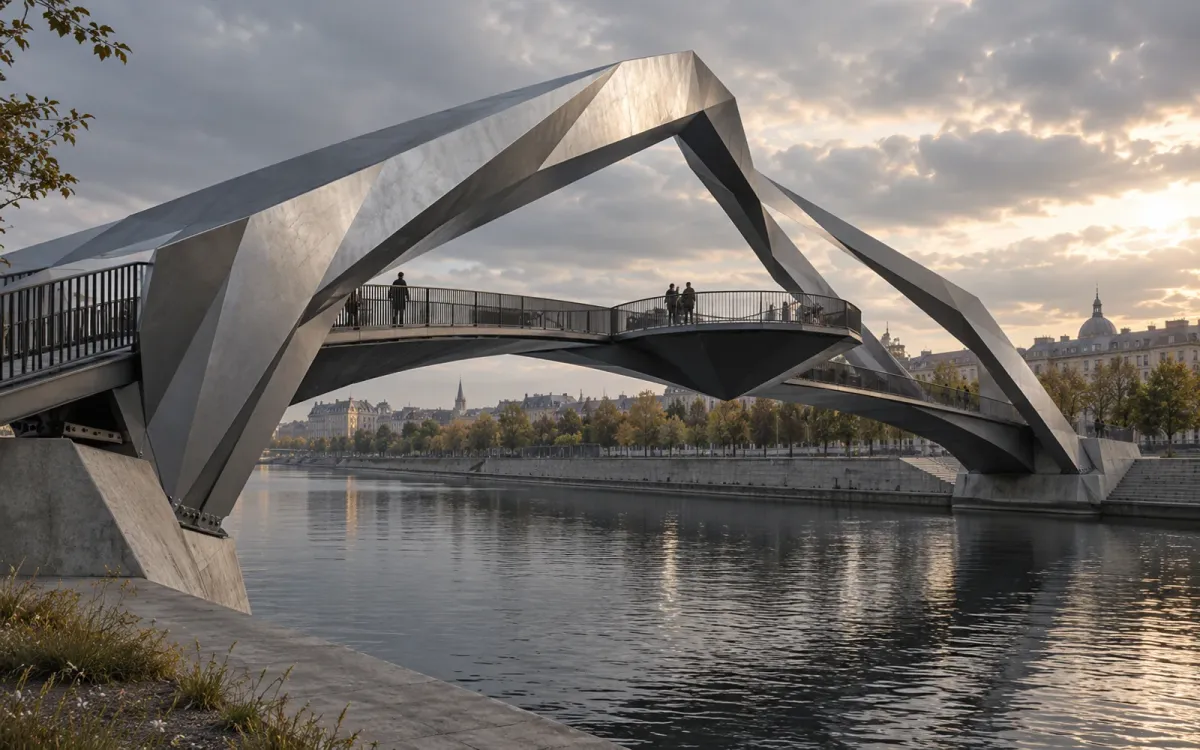
Our bridge study takes a 45 m span as a design input. We are developing the branching structure through its relationship with the pedestrian route and river. The visualization added to this article on 11 October 2026 explores angular branches around the deck and a viewing platform. It presents a design direction, without reporting structural calculations or measured material savings.
State the problem behind the form
A topology study needs a design region, support conditions, material assumptions and load cases. Without those, the resulting shape cannot be read as an answer to a defined engineering problem. Those inputs should travel with every comparison.
We would test the proposal against a simpler structural arrangement under the same assumptions. The review would need to cover geometry, connections and serviceability with the appropriate engineering expertise. A branching silhouette alone cannot explain the load path.
Bring making into the study
- Can the shape be divided into members or panels that can be fabricated?
- Can a joint be assembled, inspected and maintained?
- Where do tolerances, access and assembly order affect the geometry?
These questions may change the concept before a refined rendering is useful. A more regular member arrangement could be worth developing even if it appears less sculptural.
The next useful experiment
We would keep the inputs, comparison model and engineering feedback together, then show what changed after review. The aim is a repeatable design study whose conclusions can be traced. Until that exists, the span remains a concept parameter and performance remains a question to investigate.