Computational Urbanism
Compare what an urban intervention changes for routes, daylight and everyday use.
- Study period
- 2024-2025
- Note updated
The research question
A passage through a block changes more than walking distance. It can shift activity, affect a courtyard and connect destinations differently. We investigate how computational methods can keep these consequences visible during an urban design decision.
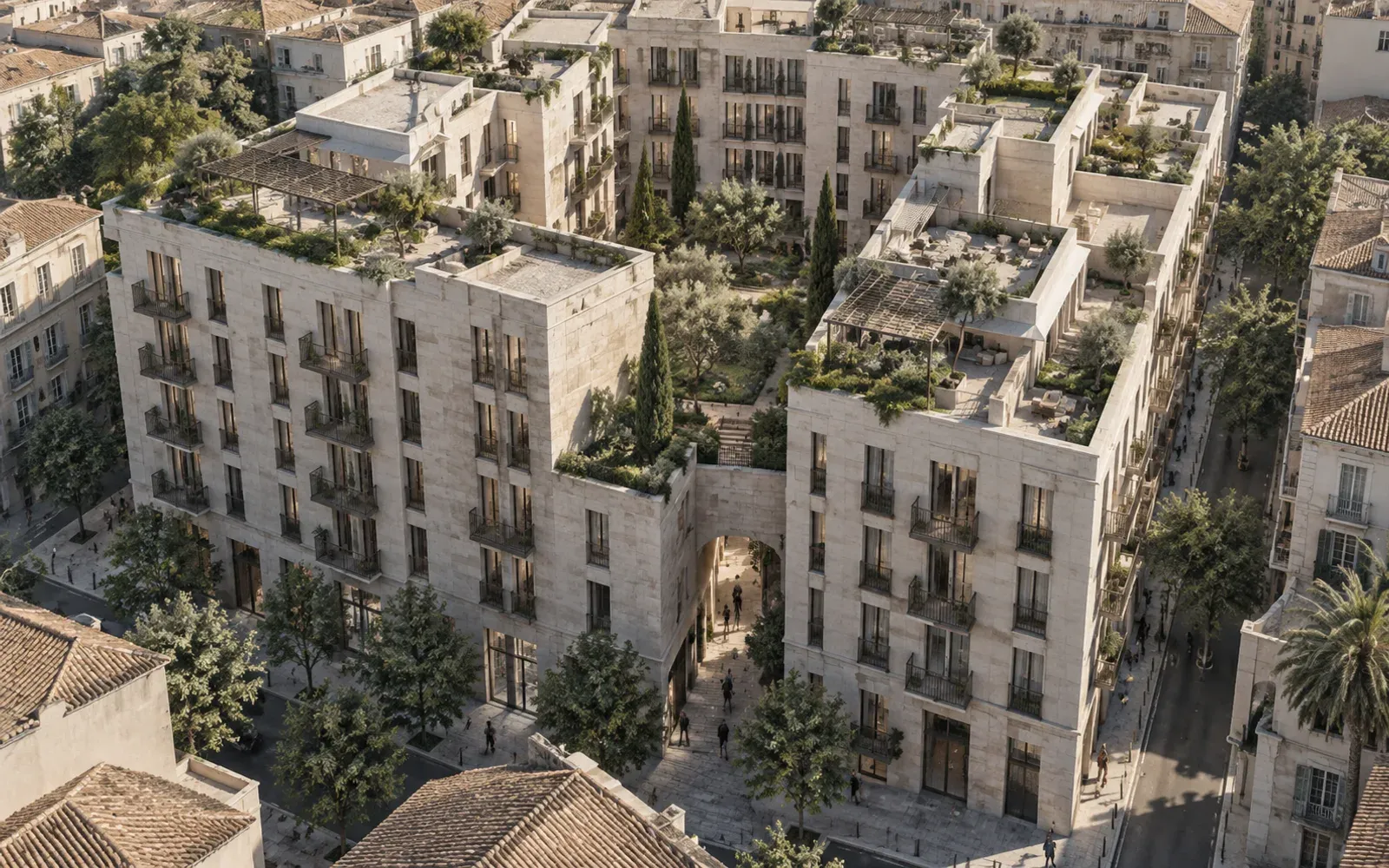
The first proposed case is an infill site near a transit stop. Programme and boundary remain fixed across a closed block, a through-passage and an open courtyard. Existing entrances and crossings will be recorded before new routes are evaluated.
We will vary destinations, time windows and environmental assumptions, then examine which conclusions remain stable. The comparison should support discussion between designers and people who use the place. A weighted score cannot substitute for that discussion.
Three ways through the same block
The route goes around the block. The street edge remains continuous, while the interior offers no through-connection.
Authored block and route diagrams. Route lines explain spatial choices; they are not pedestrian forecasts, measured travel times or an optimisation result.
Ideas and methods
Gehl and Svarre’s observation methods and reproducible street-network analysis supply complementary evidence. Easterling’s Medium Design adds attention to relationships between spatial elements. We use these perspectives to examine how an intervention changes a network, rather than evaluating an isolated form.
Observation also sets the scale of the question. A passage may shorten a route while displacing places to wait, meet or rest. Our comparison will therefore document stationary activity alongside movement and ask whose daily journey is represented by the selected destinations.
Read the sources ↓Current work and the next experiment
- On this page
- Three block arrangements with a common programme and illustrative walking routes.
- Planned output
- A source map, observed movement conditions, comparable layouts and independent evaluation.
How we will test it
- Establish the reference condition
- Record entrances, crossing permissions, slope and observed route use. Keep source dates and missing information with the network instead of silently filling gaps.
- Compare compatible alternatives
- Hold the programme, site boundary and evaluation period constant. Examine route distance, crossing exposure, daylight and open space as separate outcomes.
- Challenge the preferred result
- Repeat the comparison with changed destinations and demand assumptions. Use observations withheld from calibration to test movement predictions and describe where they fail.
What remains open
- Source data and independent experiment records are required to evaluate model accuracy.
- GIS resolution and missing activities constrain any comparison.
- Pedestrian behavior requires local calibration; a static scenario does not predict long-term urban change.
Next output
The next output is one auditable infill scenario: source map, observed reference condition, alternative layouts and a comparison sheet showing both benefits and costs. A workshop participant should be able to change an assumption and see why the conclusion moves. No predictive accuracy is claimed until a separate observation-based evaluation is complete.
Sources and method notes
- Jan Gehl and Birgitte Svarre, How to Study Public Life (2013) ↗
Observation and documentation of public life. Gehl’s account places the 2013 book within its long-running public-space research.
- Boeing, Modeling and Analyzing Urban Networks and Amenities with OSMnx (2025) ↗
Primary software paper on reproducible street-network modelling and analysis.
- Eclipse SUMO: Pedestrians ↗
Official documentation for sidewalks, crossings, walking areas and pedestrian-model choices; checked 15 September 2026.
- Keller Easterling, Medium Design (2021) ↗
Yale’s description of design through relationships between things; a conceptual reference for the urban comparison.