Controlled Architectural Revision
How can an image edit change a design decision while keeping the rest of the space consistent?
- Study period
- 2026
- Note updated
The research question
An architectural revision has two obligations: make the requested change and preserve the decisions around it. A convincing material replacement can still move a window, erase a door or shift the camera. We ask what additional context and model adaptation contribute to controlling these changes.
The unit of study is a source image, an edit brief, protected elements and a follow-up revision. Every attempt, rejection and repair belongs in the record. We will compare instructions, retrieved precedents, geometry conditioning and a trained adapter, then assess whether any gain survives on unseen projects.
Change the surface, retain the room
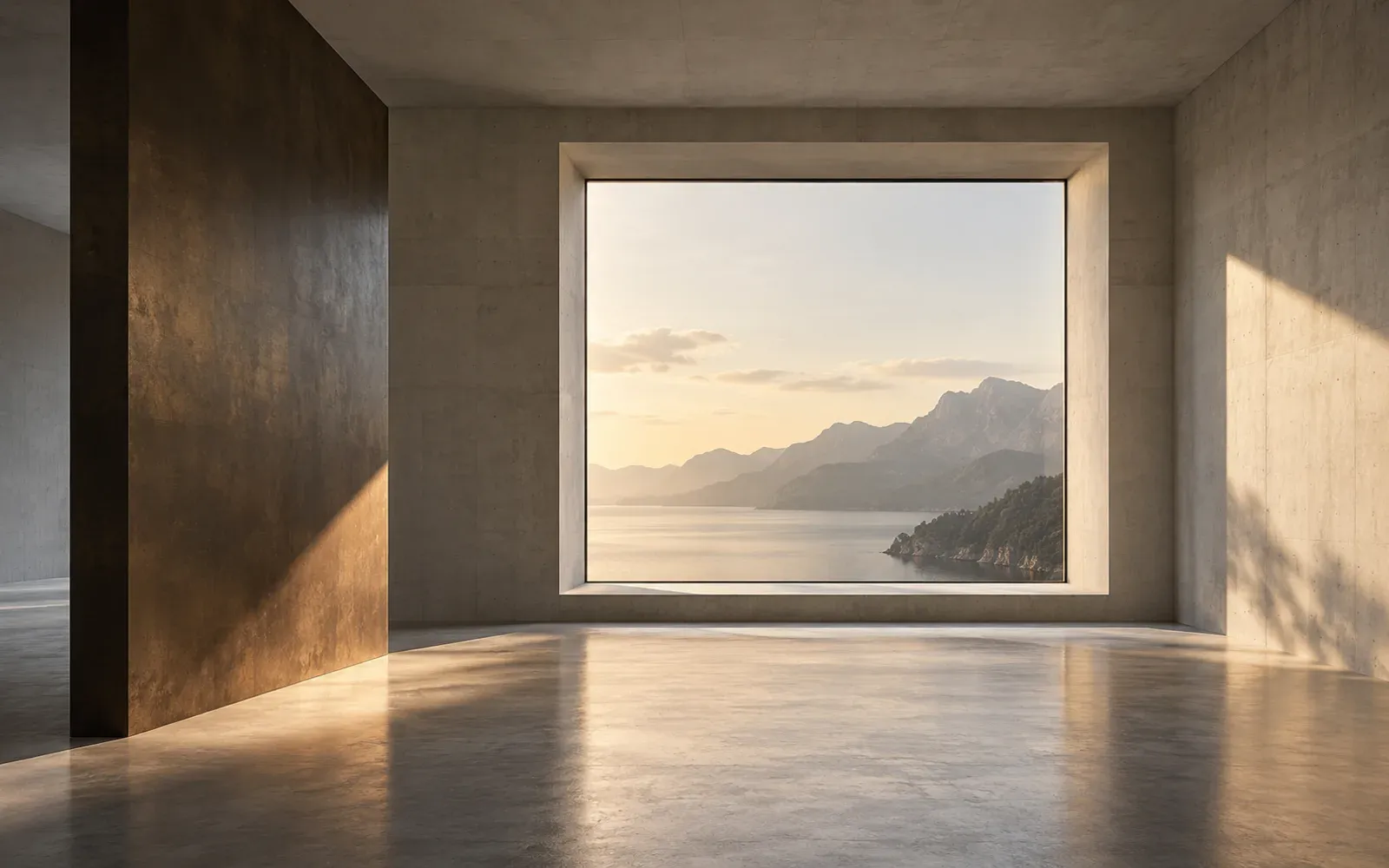
The starting condition. The window and room boundaries provide the reference for the revision.
An authored geometric example. The window, table, camera and room boundaries remain fixed. Timber lines represent an edit brief, not an image-model output or a performance result.
From image consistency to architectural acceptance
Prompt-to-Prompt and MasaCtrl explore attention control in image editing. ControlNet provides a precedent for spatial conditioning, while diffusion LoRA training offers a route to adapting a compatible open model. These are methods to investigate; none guarantees that architectural decisions remain intact.
GIE-Bench (2025) evaluates the requested change and preservation separately. GEditBench v2 (2026) evaluates visual consistency with an assessment model trained on preference data and checked against expert judgments. We use these distinctions to define an architectural review of landmarks, successive revisions and repair effort; the general benchmarks supply evaluation ideas rather than architectural acceptance criteria.
Read the sources ↓Current work and the next experiment
- On this page
- An authored room example, an edit-scope diagram and a proposed comparison of four adaptation conditions.
- Planned output
- Cleared source/target edit pairs, held-out project briefs and a versioned comparison that includes rejected attempts, reviewer decisions and repair cost. No adaptation benefit has been measured yet.
Comparing context, control and adaptation
The comparison keeps the source, brief and underlying open model fixed. Each condition adds one layer; separate frontier API runs provide a reference for the complete task.
-
Prepare architectural edit pairs
Use project images with documented permission. Pair each source with a reviewed target and a brief stating the requested change, allowed secondary effects and protected decisions. Include interior materials, facade surfaces and lighting briefs with their own protection rules. Split by project before training or tuning.
-
Register the comparison
Record model and adapter versions, prompts, masks, references, preprocessing and generation settings. Keep attempt budgets comparable and publish the protocol before scoring the test set. If seed control is unavailable, record that boundary rather than implying deterministic reproduction.
-
Add one information layer at a time
Compare the four conditions below on the same held-out briefs. For the trained condition, use only training projects and report dataset preparation and training cost. Include a control using visually similar but contextually irrelevant references to test whether retrieval adds useful knowledge.
-
Review the first and next revision
Mark protected corners, openings and furniture boundaries in the source. Set tolerances and allowed lighting effects before the trial. Present anonymous result pairs to architectural reviewers in randomized order; record uncertainty and disagreement. Then request a second change and check which earlier decisions survive.
-
Publish the complete record
Retain all generations, selected results and repair steps. Report requested-edit success separately from protected-element drift, unwanted additions and total human effort. Release replay instructions and cleared examples; if an adapter adds no value, retain that finding alongside the successful cases.
Four conditions on the same open model
The geometry and adapter conditions require a compatible pipeline. A provider model with different weights is evaluated separately; its performance cannot establish the adapter’s contribution.
- Condition A · Source and instruction
- Information supplied
The source image and explicit edit brief.
- Contribution isolated
How far does the unadapted baseline go?
- Condition B · Retrieved context
- Information supplied
A, plus relevant precedents and applicable office or project guidance.
- Contribution isolated
Does selecting appropriate context improve acceptance?
- Condition C · Spatial conditioning
- Information supplied
B, plus supported masks, edges or depth guidance.
- Contribution isolated
Does geometric control reduce changes outside the brief?
- Condition D · Trained adapter
- Information supplied
C, plus a LoRA trained on reviewed architectural edit pairs.
- Contribution isolated
Does training add value on projects excluded from training?
Score the change and what survives
- Requested change
- Review whether the named surface, material or lighting change matches the brief. Keep this score separate from overall attractiveness.
- Protected decisions
- Measure marked image landmarks relative to the source dimensions; inspect missing openings, added objects and camera drift. Check background regions under the allowed appearance changes.
- Correction effort and cost
- Record attempts, selection, repair and the time to acceptance. Account for API use, training and data preparation separately, including cases with no accepted result.
- A usable next revision
- Check whether a second edit preserves accepted earlier decisions. Compare reviewer agreement and failure categories across project types, with uncertainty rather than a single headline score.
What remains open
- Two-dimensional agreement does not verify three-dimensional geometry, BIM consistency or construction details. Perspective and occlusion can make image checks ambiguous.
- A style adapter may improve appearance without improving decision preservation. Context retrieval may also introduce misleading precedents.
- Closed API models may not expose weight training, internal conditioning or stable versions. Their task-level results must remain separate from the fixed-backbone adaptation experiment.
- Automated image or model-judge scores are supporting evidence. Architectural acceptance and reviewer disagreement remain part of the record.
- The comparison, training dataset and model adaptation described here are proposed research, not delivered product capabilities.
A comparison another architect can inspect
The first deliverable will be a checked edit set, a protection rubric and a replayable comparison. It will show where each method helps, where it fails and what the architect must still correct. Only then can we assess whether contextual knowledge or training belongs in a useful design tool.
Sources and method notes
- Hertz et al., Prompt-to-Prompt (2022) ↗
Attention control for text-guided image editing. A technical precedent for source composition, not a test of architectural correctness.
- Cao et al., MasaCtrl (2023) ↗
Mutual self-attention for consistent image synthesis and editing. Motivates a control baseline without additional model training.
- Zhang, Rao and Agrawala, ControlNet (2023) ↗
Spatial conditioning of diffusion models. Supports the geometry-guidance question where the selected pipeline is compatible.
- Diffusers: LoRA training ↗
Official diffusion-adaptation documentation. Supports a limited-parameter training method; architecture-specific benefit requires the proposed comparison.
- Qian et al., GIE-Bench (2025) ↗
Primary method for evaluating instruction execution and preserved content separately. Its general tasks do not establish architectural acceptance.
- Jiang et al., GEditBench v2 (2026) ↗
Primary research on human-aligned visual-consistency evaluation. Informs anonymous pairwise review, with an additional architectural rubric here.