AI this week: tighter edits, longer clips, buildings as code
Three releases from the first week of November, read for what they change in an architect's review loop.
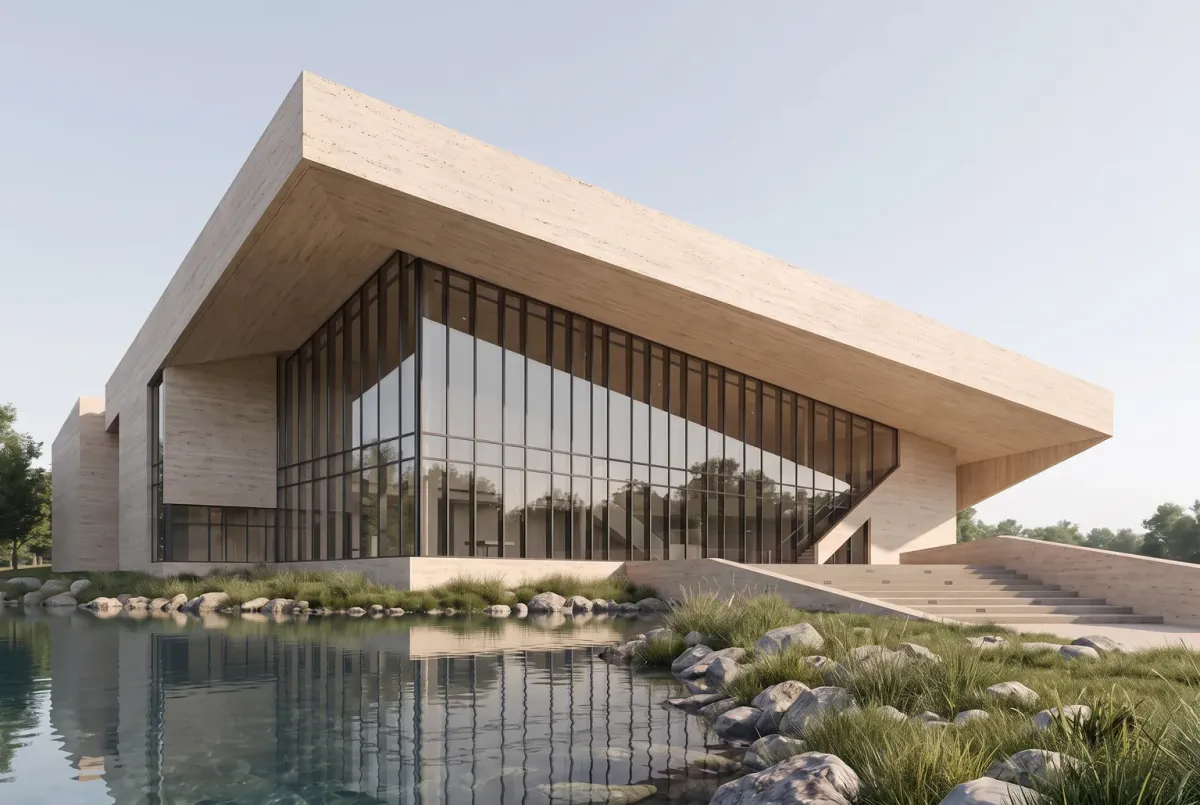
The three releases we picked this week are about control rather than first impressions: pointing at the part of an image that should change, refining a clip through conversation, and recovering a building as a program that can still be edited. Those are the moves an architect makes in a review, so we read each release through that lens.
OpenAI Images 2.6: marking the area to change
OpenAI released Images 2.6 on 4 November across ChatGPT, Codex and the API. In the API it comes as two models: Flare for fast iteration and Sunburst for detailed visual work. Photo markup now works in ChatGPT and in the API. You circle or sketch over the part to change, so a tool can show exactly where an edit should happen. The release also adds animated GIFs. The API gains SVG output and a complexity setting for how much the model plans before rendering.
For visualization, markup is the interesting part. Architects already review renders by circling a facade panel or a piece of furniture. An edit that stays inside that mark would fit the way a view is revised. Whether a building’s geometry stays stable across several rounds is something to test on real projects, not to assume from a product page.
Gemini Omni 1.2 Flash: longer clips, edited by conversation
Google released Gemini Omni 1.2 Flash on 5 November. Clips can now run from 3 to 15 seconds, set in one-second steps. A clip can be refined through follow-up prompts, such as a new background, different light or another aspect ratio, without starting again. References can be images, motion clips of up to three seconds and audio. The model is available in the Gemini API and on Google Cloud. Fifteen-second videos are rolling out in the Gemini app for Google AI Ultra subscribers and are available in Google Vids. Google says it is still improving fast action and complex physics.
Fifteen seconds is enough for a short approach to a building or a slow pan across an interior. Conversational editing suggests a way to try the same space at another time of day without rebuilding the shot. Google describes faces, garments, packaging and brand colours staying consistent across camera angles. How well walls, openings and proportions hold over a camera move is still an open question for architecture.
From a single photo to an editable building program
A paper posted to arXiv on 2 November, “Visual-to-Executable Procedural Reconstruction of Buildings” (Zhu et al.), recovers a procedural building model from photographs taken in the wild. It first recovers the facade’s split-and-repeat layout, then maps representative facade tiles to procedural attributes. Both are compiled into an executable CGA program attached to a simple mass model. The authors set the scope plainly: a single image gives only partial evidence, so they recover the dominant visible facades and keep the overall form a simple mass. The abstract does not mention a code release.
The result is a set of rules rather than a mesh, so a window rhythm could in principle be changed after reconstruction. Our Lab asks a related question at the scale of a room in Scan to Editable Model: what must a captured space keep so that an edit does not break it?
What connects them
None of these releases makes architectural judgement automatic. They do move generation closer to revision: a mark on an image, a follow-up instruction, a parameter that can be changed. That is where we will keep testing them.